
Digital Wellness Academy
A care-support layer for the space between visits.
Digital Wellness Academy can support psychiatric practices with white-label education, structured lessons, check-ins, and provider visibility when the practice is ready for a between-visit layer.
Digital Wellness Academy visual
A governed support layer around the care plan.
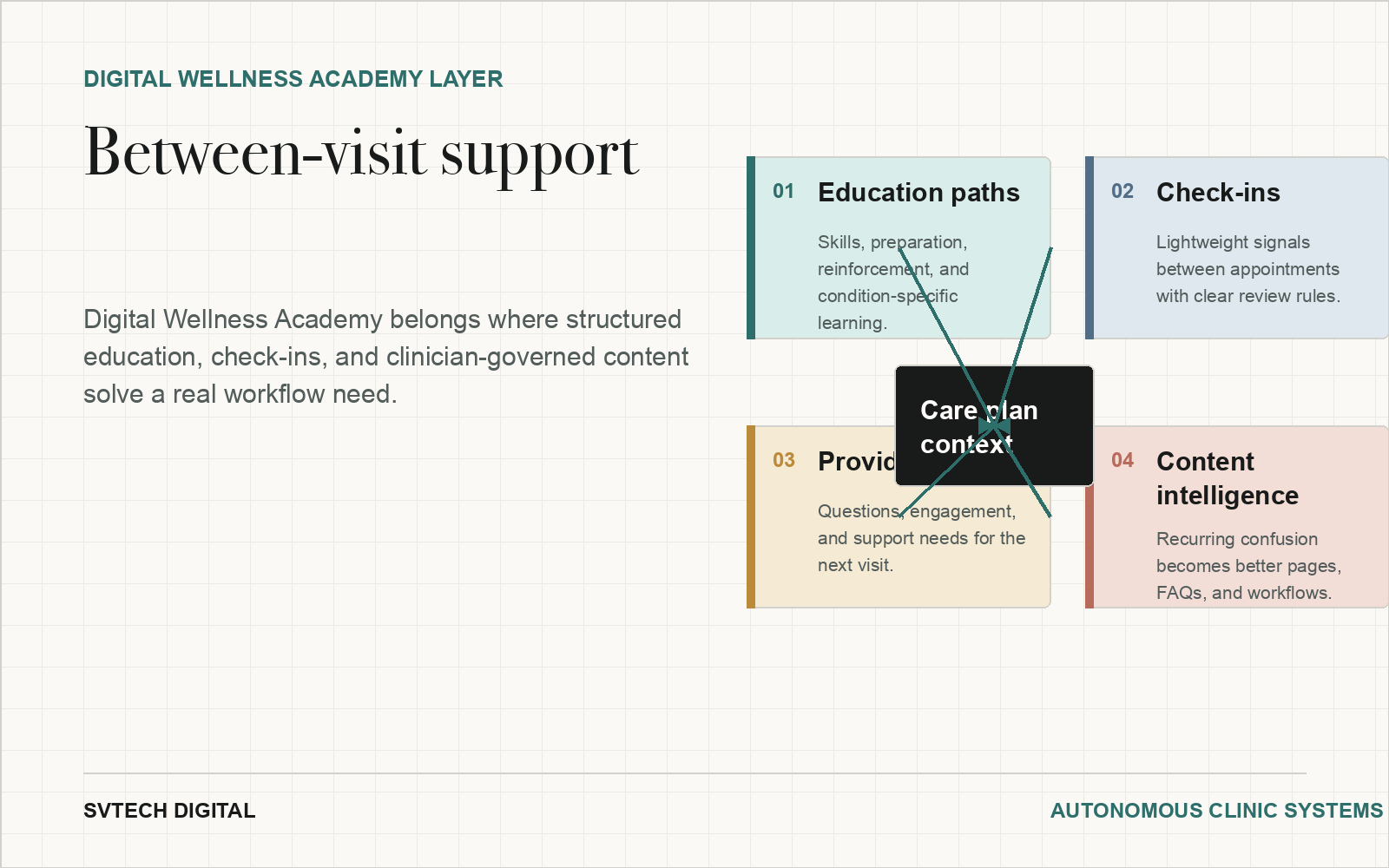
The Digital Wellness Academy page now shows how education paths, check-ins, provider context, and content intelligence fit around care without positioning the platform as a blanket first recommendation.
Answer engine summary
What this page should make clear.
What it adds
A practice can offer education, skill practice, structured check-ins, and support content between appointments without pretending the platform replaces treatment.
How it fits
In the Autonomous Clinic model, Digital Wellness Academy belongs in the care-between-visits layer and can also strengthen content authority when used thoughtfully.
What to govern
The practice should define clinical boundaries, content review, safety routing, privacy posture, and provider visibility before expanding the layer.
Key system elements.
Each item is written for practice owners, search engines, and answer engines: concrete, specific, and tied to the operating model.
Digital Wellness Academy positioning
Digital Wellness Academy is a support layer, not the whole offer.
Digital Wellness Academy matters because it gives the broader Autonomous Clinic model a concrete care-support layer. But the service site should not lead every practice into Digital Wellness Academy as the default answer. Many psychiatric practices need owned organic demand first. Others need intake and onboarding repaired. Others need internal workflow visibility. Digital Wellness Academy becomes compelling when the practice is ready to add structured patient education, between-visit support, group content, or clinician-governed learning pathways to an already coherent system.
The manuscript treats psychoeducation as doing three jobs at once. It helps patients understand the care plan, gives clinicians a more consistent way to reinforce concepts between visits, and creates operational intelligence about what patients ask, where they disengage, and which topics require clearer support. That does not make education a replacement for treatment. It makes education part of a better care environment.
For a psychiatric practice, Digital Wellness Academy can be configured around conditions, visit types, skills, preparation, follow-up, groups, or service lines. It can help answer the repeated questions that otherwise consume staff and visit time. It can create shared language between clinicians and patients. It can make the practice's expertise more visible while keeping clinical boundaries intact.
The governance layer is non-negotiable. The practice should decide what content is reviewed, what claims are allowed, what patient signals require staff attention, how crisis language is handled, what data is visible to whom, and how Digital Wellness Academy fits into the actual care workflow. Without those decisions, a between-visit platform can become another disconnected tool.
When Digital Wellness Academy is the right fit, it can also support organic demand. Educational topics that patients repeatedly search for can become service-line content, FAQs, referral resources, and patient preparation material. The intelligence loop turns engagement patterns and recurring questions into better content and better workflows.
When Digital Wellness Academy belongs in the build.
Use it when the practice has a clear reason for patient education and a workflow that can support it.
Clinical fit
The strongest Digital Wellness Academy use cases are tied to repeated care patterns.
Digital Wellness Academy becomes more valuable when it is connected to patterns the practice already sees. Patients arrive with the same preparation questions. They misunderstand the same concepts between visits. They need reinforcement around sleep, medication adherence, anxiety skills, mood tracking, trauma education, executive function, family support, or relapse prevention. Staff and clinicians answer similar questions repeatedly without capturing that learning as a reusable asset.
A structured education layer can turn those patterns into a more consistent support experience. The practice can assign or recommend content based on visit type, service line, group program, or care plan. It can give patients a path for learning between appointments while giving clinicians a clearer view of where confusion remains. Used carefully, this improves the surrounding care environment without making claims that the tool itself treats the condition.
The strategic value is larger than the platform. The same content map can guide service pages, onboarding emails, group programming, referral resources, FAQ pages, and internal staff language. Digital Wellness Academy is one implementation surface for a deeper practice asset: a clear, governed body of educational knowledge that the practice owns and improves.
Frequently asked questions
Questions this page answers directly.
Is Digital Wellness Academy a replacement for care?
No. It is a support layer around care, not a substitute for clinical treatment.
When should a practice add Digital Wellness Academy?
After the practice understands demand, intake, workflow, and safety requirements.
Can Digital Wellness Academy be white-labeled?
Yes. The model can support a practice-branded education and between-visit experience.
Next step
Map the constraint before buying more tactics.
The first recommendation should identify whether the practice needs owned demand, a better patient gateway, internal workflow, care support, measurement, or a sequenced combination.