
Owned Demand Infrastructure

Build owned organic demand.

Increase qualified discovery across Google, local search, service-line content, and referral paths, then tighten intake, onboarding, internal workflow, patient education, and follow-up so new demand becomes scheduled, prepared care.

01Earn qualified demand from organic search
02Move inquiries through a faster patient gateway
03Use workflow data to improve the system every month
Owned demand Patient gateway Practice nervous system Care between visits Intelligence loop

The Core Thesis

Most psychiatric practices do not have a marketing problem. They have a system-design problem.

The demand already exists. The question is whether the practice owns a path for being found, has a gateway that can absorb new inquiries, and can see where patients, staff, and information get stuck.

Visual model

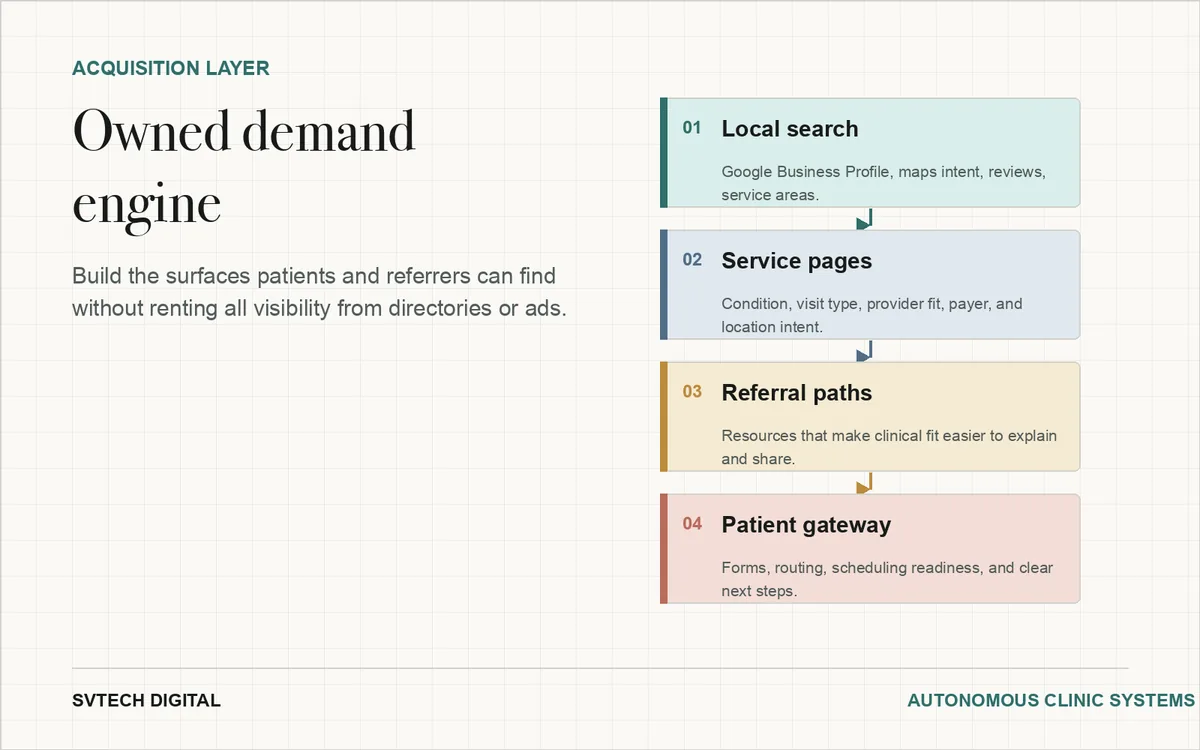
Owned demand has to connect to the gateway.

Organic discovery only matters if the practice can turn qualified interest into completed next steps. This visual gives the homepage a clear acquisition story without making the offer feel like one rigid platform.

Infographic showing local search, service pages, referral paths, and patient gateway as an owned demand engine.
Owned demand is the first layer, not the whole system.

Start with the constraint, not the tool.

The manuscript’s first diagnostic is simple: is the practice acquisition-limited, operations-limited, or both? The answer determines whether the next build should focus on owned visibility, intake capacity, internal coordination, care support, or measurement.

01

Acquisition-limited practices are too dependent on rented visibility.

Directories, paid ads, and passive referrals can still matter, but they do not build authority the practice keeps. Owned demand comes from local search, service pages, credentialed content, and referral paths that compound.

02

Operations-limited practices lose patients after interest appears.

Calls, forms, insurance fit, scheduling, signatures, reminders, and staff handoffs become a manual maze. More demand only helps if the patient gateway can turn inquiry into prepared care.

03

Practices with both constraints need sequencing, not more activity.

If intake is already dropping leads, pouring more traffic into it makes the problem worse. If demand is thin, automation alone does not create patients. The build order matters.

The operating model

The Autonomous Clinic is built in layers, not features.

The homepage should not sell a single tactic. It should show the system: owned demand, automated patient gateway, practice nervous system, care between visits, and a loop that turns real data into better decisions.

Owned Demand

Build the local, condition-specific, insurance-aware, and referral content surfaces directories cannot create for the practice.

Gateway

Turn inquiry into completed forms, signed documents, scheduling readiness, and clear next steps without front-desk drag.

Nervous System

Document the workflows, ownership rules, task lanes, and shared operating knowledge that keep the practice from running on memory.

Between Visits

Add patient education, structured support, and clinician-governed content only where it strengthens care and retention.

Intelligence

Use search, intake, no-show, patient-question, and staff-load data to improve the system every month.

Workflow console Diagnose / Build / Measure
01 Diagnose the constraint

Demand, intake, workflow, or measurement.

02 Build the first layer

Owned demand, patient gateway, or operating system.

03 Measure the loop

Use search, intake, no-show, and staff-load signals.

Owned demandSearch / Local / Referral
Patient gatewayCapture / Schedule / Onboard
Practice nervous systemRoles / Handoffs / Follow-up
Between visitsEducation / Support / Readiness
Intelligence loopSignals / Decisions / Improvements

What gets installed

The right build depends on the bottleneck.

Some practices need owned demand because the right patients are not finding them. Others need a patient gateway because demand is already being wasted. More mature groups may need internal workflow, care-between-visits support, or practice intelligence.

01Owned demand engine

Local search, condition pages, insurance pages, referral paths, and content authority.

02Automated patient gateway

Forms, e-signature, scheduling readiness, reminders, and inquiry-to-intake routing.

03Practice nervous system

SOPs, staff lanes, handoffs, shared knowledge, and internal coordination.

04Care between visits

Patient education, structured check-ins, group support, or Digital Wellness Academy informed content layers.

05Measurement dashboard

Search performance, form completion, response time, no-shows, and staff load.

06Governed AI readiness

Shadow-AI policy, tool boundaries, BAA discipline, and safe automation sequencing.

A ninety-day sequence, not a pile of tactics.

The manuscript is explicit about order: establish ground truth, fix the highest-leverage bottleneck, then measure what changed. AI tools, education layers, and intelligence systems come after the foundation can absorb them.

Days 1-30 / Diagnose

Pull real numbers: source of the last twenty patients, response speed, intake completion, no-shows, Search Console, Google Business Profile, and the highest-risk undocumented workflow.

Days 31-60 / Build

If demand is thin, build owned acquisition. If operations are leaking, automate intake and handoffs first. If both are constrained, stabilize the gateway before adding more traffic.

Days 61-90 / Measure

Compare before and after: acquisition, intake time, form completion, no-show rate, staff hours, service-line demand, and patient questions. Let the numbers choose the next layer.

Year one / Extend

Add patient education, AI-assisted front desk, care-between-visits tools, or advanced dashboards only after the foundation is visible, governed, and actually being used.

What the case proves, and what it does not.

The anonymized case in the manuscript is evidence, not a promise. It shows what becomes possible when owned demand and intake automation are treated as practice infrastructure rather than a cheap marketing expense.

Case signal

A psychiatric practice grew from one clinician to four active clinicians while taking in roughly forty new patient intakes per month.

Owned demand

The maintained organic system produced a 142 percent increase in form submissions and a 32 percent increase in Search Console clicks.

Gateway

Manual onboarding moved from roughly forty-five minutes to a one-to-ten-minute digital intake and signature workflow.

Discipline

The lesson is not a guaranteed patient count. It is the need to measure, price, protect, and continuously maintain the system that creates growth.

Next step

Start with a constraint audit.

Bring the path as it exists today: how patients find you, how they reach out, how intake works, what staff chase manually, and what you can actually measure. The first recommendation should identify whether the practice needs owned demand, a better patient gateway, internal workflow, care support, or a measurement loop.

More from our network