Services and engagement models

Growth systems for psychiatric practices.

These services help psychiatric practices earn demand from search, local intent, referrals, and educational content, then capture more of that demand, respond faster, onboard patients smoothly, coordinate the team, and add education or collaboration layers only where they solve a real bottleneck.

Service map

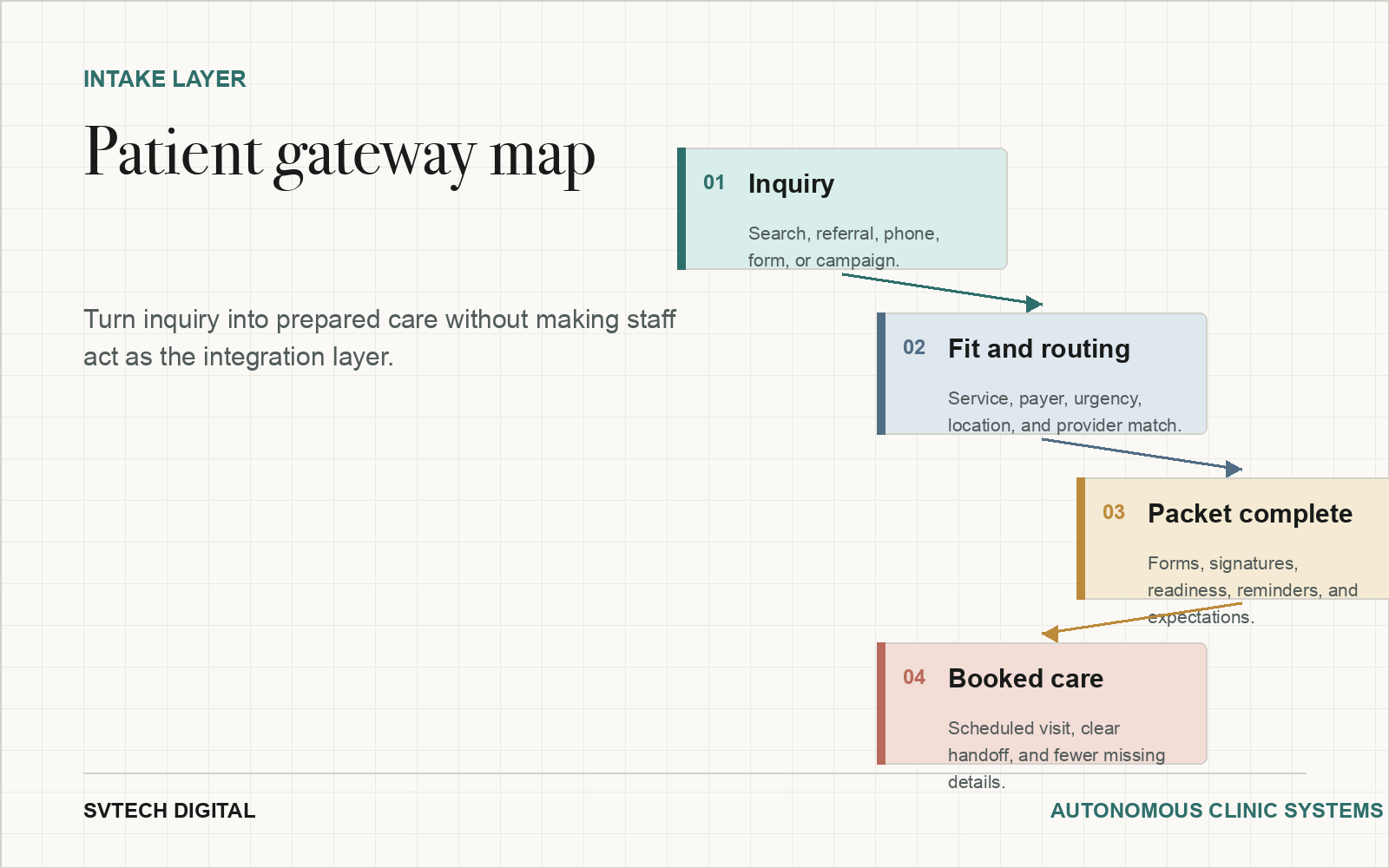
The patient gateway is where demand becomes care.

Follow each inquiry through fit routing, packet completion, and booked care so the practice can see where qualified demand turns into operational drag.

Infographic showing inquiry, fit routing, packet completion, and booked care in a psychiatric patient gateway.
Use this when a practice has interest but too much drag before the first appointment.

Six ways to create demand without adding drag.

Each engagement targets a common practice bottleneck. The goal is not to install everything; it is to build the right organic traffic engine first, then the operational layer needed to convert and support it.

01

Organic Traffic Growth Audit

Map where the practice is missing organic demand, and where patient acquisition, intake, scheduling, onboarding, follow-up, and staff workflow are leaking value.

  • Current-state map across search demand, service pages, lead capture, intake, scheduling, care start, and retention.
  • Bottleneck diagnosis with the highest-leverage organic traffic or workflow fix.
  • Prioritized organic growth and implementation plan.
Best first step when the practice needs more qualified demand but the best path is still fuzzy.
02

Lead Capture and Scheduling Flow

Make it easier for high-intent visitors and referred patients to take the next step, and easier for staff to route them correctly.

  • Website forms, calls, search landing pages, routing logic, and next-step language.
  • Fit, insurance, urgency, and appointment-readiness questions.
  • Response templates, reminders, and conversion visibility.
Best once organic or referral demand is starting to arrive but too many inquiries stall.
03

Patient Onboarding Workflow

Reduce confusion, missed forms, no-shows, and staff chasing before the first appointment.

  • Welcome sequence, forms, expectations, reminders, and preparation materials.
  • Staff handoff rules from inquiry to scheduled visit.
  • First-visit readiness checks and no-show reduction workflow.
Best when intake feels messy or overly manual.
04

Internal Workflow Layer

Create shared visibility for admin, intake, clinical, billing, and follow-up work without adding another confusing inbox.

  • Shared work queues, ownership rules, task states, and handoff language.
  • Groupware-style collaboration for programs, cohorts, or internal operations.
  • Simple dashboards for status, aging, blockers, and follow-up.
  • Documentation and monitoring workflows that reduce charting time and can support CPT-aligned remote therapeutic monitoring billing when Digital Wellness Academy is part of the build.
Best when work is scattered across people and tools.
05

Patient Education Layer

Turn education, groups, classes, or digital wellness content into a practical support layer around care and an organic content engine when appropriate.

  • Condition, visit-type, or service-line education paths.
  • Patient-facing assignments, reminders, and progress visibility.
  • Platform selection or configuration, including Digital Wellness Academy when it is the right fit.
Best when support between visits should be structured but not overbuilt.
06

Practice Intelligence Engine

Use what prospects and patients search, ask, start, abandon, complete, and struggle with to improve growth and operations.

  • Question and friction taxonomy from leads, patients, and staff interactions.
  • Service-line and content strategy informed by real search and patient demand.
  • Dashboard logic for traffic, conversion, onboarding, engagement, and bottlenecks.
Best for owners who want the practice to learn every month.

Explore the growth constraint in front of you.

These service pages answer the questions psychiatric practice owners most often bring to a first conversation. Choose the page that best matches the current bottleneck.

01

Psychiatrist SEO Services

Build service-line, local, and content visibility around the searches patients and referrers already make.

03

Patient Intake Automation

Reduce duplicate work across inquiry, fit routing, forms, signatures, reminders, and handoffs.

04

Google Business Profile

Align local discovery, practice information, service detail, and the next step into care.

Engagement structures.

Pricing follows scope and readiness. Start with the engagement that matches the current constraint, then define the detailed proposal.

Growth Flow Audit

Focused diagnostic engagement. Produces an organic traffic map, priority sequence, and implementation recommendation.

Organic Traffic Sprint

Four to six weeks to improve organic landing paths, service pages, capture, routing, scheduling, reminders, and conversion visibility.

Onboarding Build

Design and test the intake, preparation, forms, messaging, staff handoffs, and first-visit workflow.

Ongoing Systems Partner

Monthly optimization across organic traffic, acquisition, conversion, onboarding, staff load, patient experience, and new capabilities.

Important framing

This is organic traffic infrastructure, not another software mandate.

The work is designed to help the right patients find the practice through organic search and local intent, understand the next step, and move through the first part of care with less friction. Some fixes are content and search strategy. Others are messaging, routing, staff ownership, or a better first-touch experience.

  • No recommendation starts with a platform before the organic and workflow bottleneck is understood.
  • Implementation should align with compliance requirements, EHR realities, team roles, and payer environment.
  • Patient education, groups, collaboration tools, and automation are options, not assumptions.
  • If readiness does not support a large build, the recommendation should be a smaller first workflow.

What the first call should answer.

Instead of a generic sales pitch, the call should produce a practical answer to where the practice has the most leverage: visibility, conversion, onboarding, workflow, education, or reporting.

A

Where are prospective patients dropping off?

Search result, service page, referral, website, phone, form submission, callback, insurance fit, scheduling, paperwork, or first appointment?

B

What does the team need to know next?

Who owns the lead, what is blocking the patient, what message goes out, and what is the next best action?

C

Which fix pays for itself first?

More booked consults, faster response, fewer no-shows, less staff chasing, better onboarding, or stronger retention.

Next step

Start with the organic traffic your practice should be earning.

Bring the path as it actually exists: which services should grow, how patients find the practice now, what they see, how they reach out, how they get scheduled, and what happens after the inquiry. The first recommendation identifies organic traffic opportunities, then the capture, scheduling, onboarding, collaboration, education, or reporting fixes needed to support them.

More from our network