
Case study
What one real practice proves, and what it does not.
The manuscript uses a real anonymized case to show why owned demand and intake infrastructure should be treated as an operating asset, not a cheap marketing expense.
Case visual
Evidence, not a guarantee.
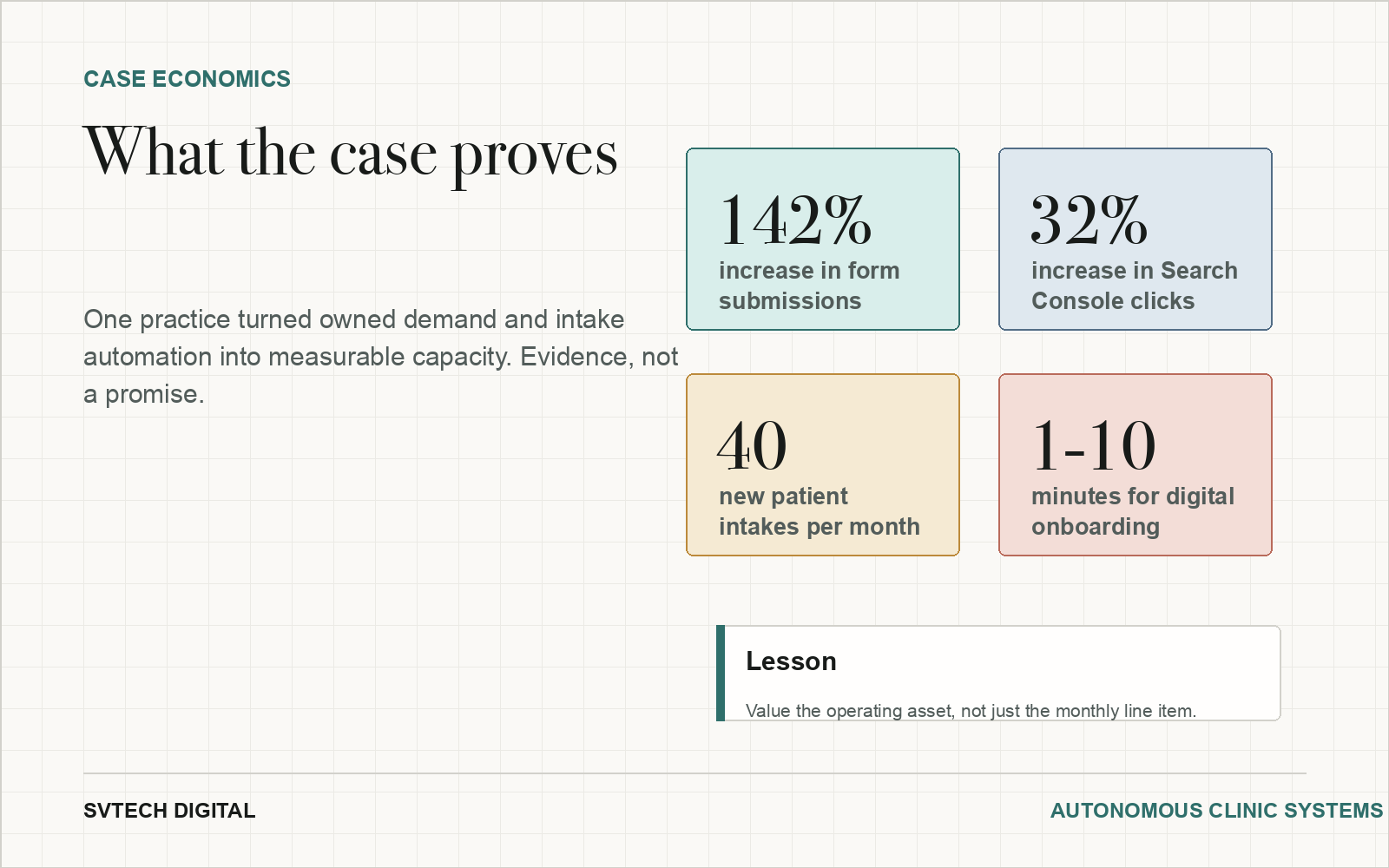
The case study now has a shareable visual that frames the proof points carefully: form lift, Search Console lift, monthly intake volume, and onboarding time.
Answer engine summary
What this page should make clear.
Owned demand
The maintained organic system produced a 142 percent increase in form submissions and a 32 percent increase in Google Search Console clicks.
Patient gateway
Manual onboarding moved from roughly forty-five minutes to a one-to-ten-minute digital intake and signature workflow.
The lesson
The lesson is not that every practice should expect the same numbers. The lesson is that an owned growth system has measurable value and should be priced, protected, and maintained.
Key system elements.
Each item is written for practice owners, search engines, and answer engines: concrete, specific, and tied to the operating model.
Case interpretation
The numbers matter because they reveal infrastructure value.
The manuscript opens with a small dollar decision because the small number exposes the larger strategic problem. A psychiatric practice had grown from one clinician to four and was taking roughly forty new patient intakes per month. The system behind that growth included organic search and content work that drove a 142 percent increase in form submissions and a 32 percent increase in Google Search Console clicks, plus an automated intake and signature workflow that reduced onboarding from roughly forty-five minutes to somewhere between one and ten minutes.
The mistake was not simply that the practice disliked a higher monthly fee. The mistake was that the practice had no framework for valuing what had been built. It treated a compounding acquisition system and a time-saving patient gateway as a low-cost expense instead of an owned operating asset. That is the lesson another practice should take from the case.
Owned demand has value because it keeps working after a single campaign ends. A condition page, service-line page, local search asset, referral page, or educational resource can continue to answer patient intent, strengthen authority, and feed the intake path. The value is not just the traffic number. It is the combination of discoverability, trust, conversion, and lower dependence on rented channels.
The automated gateway has value because time saved at intake is not abstract. When staff no longer chase every missing form, signature, insurance detail, scheduling question, or next-step reminder manually, the practice gains capacity. The owner can estimate that value from intake time saved, staff hourly cost, number of new intakes, and reduction in avoidable follow-up touches.
The case does not prove that every practice will see forty new patients per month. It does not prove that SEO alone solves growth. It does not prove that automation should be installed before the practice knows its bottleneck. It proves something narrower and more useful: when demand and intake are built together, the result can be measured, valued, and protected.
That is why the case belongs on a services site. It gives a practice owner a way to ask better questions: What demand do we own? What do we rent? How many qualified inquiries do we waste? How much staff time does onboarding consume? Which pages, sources, and workflows create booked care? Which numbers would change our next decision if we reviewed them monthly?
What another practice should copy, and what it should not.
The useful part of the case is the operating logic, not the exact patient count.
Frequently asked questions
Questions this page answers directly.
Are the case numbers guaranteed?
No. The site should present them as evidence from one implementation, not a promise.
Why does the case matter?
It shows that owned demand and intake workflow are practice infrastructure, not isolated marketing tasks.
What should a practice compare against?
Compare against current patient source mix, response time, intake completion, staff time, and organic inquiry volume.
Next step
Map the constraint before buying more tactics.
The first recommendation should identify whether the practice needs owned demand, a better patient gateway, internal workflow, care support, measurement, or a sequenced combination.