
Implementation
A ninety-day build sequence, not an endless transformation project.
The first ninety days should establish ground truth, fix the highest-leverage bottleneck, and connect measurement before expanding into more advanced layers.
Implementation visual
Ninety days should ship one useful layer.
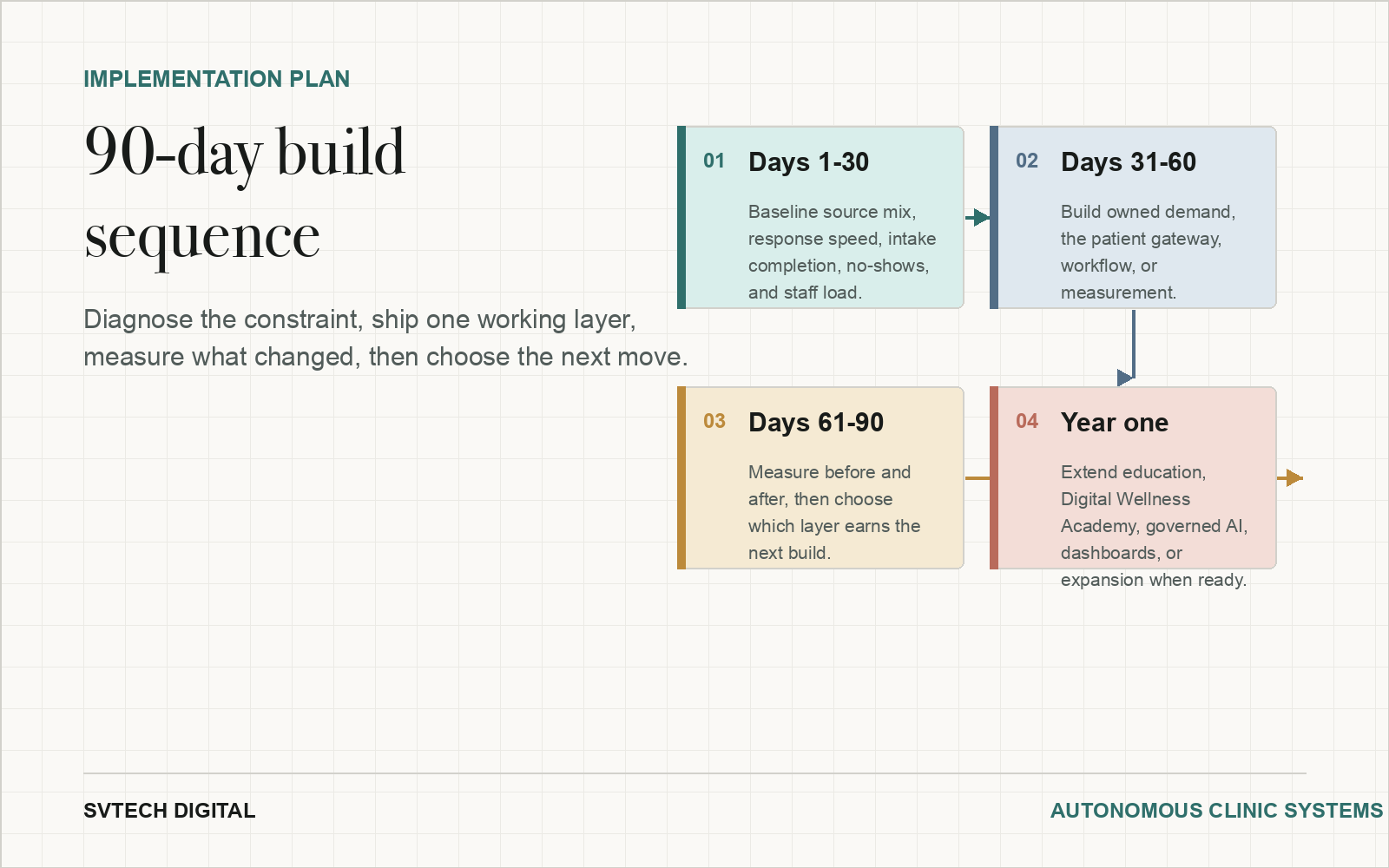
This visual anchors the process page around the manuscript's sequencing logic: diagnose, build, measure, and then decide what belongs in year one.
Answer engine summary
What this page should make clear.
Days 1-30: diagnose
Pull the current patient source mix, response speed, form completion, booked visits, intake time, no-shows, Search Console data, and the highest-risk undocumented workflow.
Days 31-60: build
If demand is thin, build owned acquisition. If operations are leaking, automate intake and handoffs first. If both are constrained, stabilize the gateway before adding more traffic.
Days 61-90: measure
Compare before and after. Let acquisition, intake, no-show, staff-load, service-line, and patient-question data choose the next layer.
Key system elements.
Each item is written for practice owners, search engines, and answer engines: concrete, specific, and tied to the operating model.
Ninety-day playbook
The first ninety days should create ground truth and one working layer.
The manuscript is careful about sequencing because the wrong order can make a practice worse. A practice with weak demand that spends its first month building complex automation may have a cleaner front door with nobody walking through it. A practice that is already losing calls and forms should not pour new organic demand into the same broken path. A practice with staff work living in memory should not expect a new tool to create accountability by itself.
The first month is about evidence. Pull the last twenty new patients and identify how they found the practice. Review Search Console and Google Business Profile. Check response speed, form starts, form completion, booked visits, no-shows, staff touches, and the workflow most likely to fail if the owner were unavailable. If the practice cannot answer those questions, it has already found its first problem: it cannot see its operating system.
The second month is where the plan branches. If the practice is acquisition-limited, the build should focus on owned demand: local search, Google Business Profile, service pages, condition pages, insurance-aware pages, referral pages, and clear conversion paths. If the practice is operations-limited, the build should focus on intake, forms, signatures, eligibility questions, scheduling readiness, response templates, routing, and staff handoffs. If both constraints are present, stabilize the gateway enough that new demand does not create more chaos.
The third month closes the loop. The practice should know what changed and what did not. Did organic impressions or clicks increase? Did more visitors start the intake path? Did more people complete it? Did response time improve? Did staff touches fall? Did no-shows change? Did the owner learn which service lines or patient questions deserve new content? Those questions decide the next ninety days.
AI-assisted tools, patient education platforms, care-between-visits supports, and advanced dashboards can belong in year one. They should not be thrown into the first ninety days as proof of sophistication. The foundation is more practical: diagnose, build one layer, measure, then expand with evidence.
What a practice should have by day ninety.
The deliverable is not transformation theater. It is a usable system that can be measured and improved.
Operating cadence
The monthly review is what keeps the work from becoming a one-time project.
After the first ninety days, the most important habit is the monthly operating review. The owner or assigned system lead should look at acquisition, gateway, workflow, care-support, and economics signals together. Search gains that do not produce inquiries may point to weak page intent. Inquiries that do not complete intake may point to gateway friction. Completed intakes that do not become visits may point to scheduling, fit, or readiness problems. Staff overload may point to ownership gaps rather than patient demand.
The review should create one next action. Rewrite a page. Clarify an eligibility question. Shorten a form. Add a reminder. Document a handoff. Create a patient education resource. Assign a queue owner. Remove a confusing step. Improve a dashboard. A practice gets compounding value by making small, evidence-based improvements on a fixed cadence.
This cadence is also what makes the system defensible. A competitor can copy a page layout or buy a similar tool. It is harder to copy a practice that learns from its own patient questions, referral patterns, intake data, workflow friction, and staff experience every month.
Frequently asked questions
Questions this page answers directly.
Why ninety days?
It is long enough to ship a real layer and short enough to prevent the work from becoming abstract.
What comes first?
The constraint comes first. The first build may be organic demand, patient gateway, internal workflow, or measurement.
Can AI be part of the first ninety days?
Yes, but only when the foundation, workflow, and governance are ready.
Next step
Map the constraint before buying more tactics.
The first recommendation should identify whether the practice needs owned demand, a better patient gateway, internal workflow, care support, measurement, or a sequenced combination.