Search intent: AI search for psychiatric practices. This guide is written for owners and clinical directors who need practical systems rather than marketing slogans.
Source-informed from manuscript Chapter 4: AI Search, AEO, structured answers, and the limits of special schema claims.
The answer in one paragraph
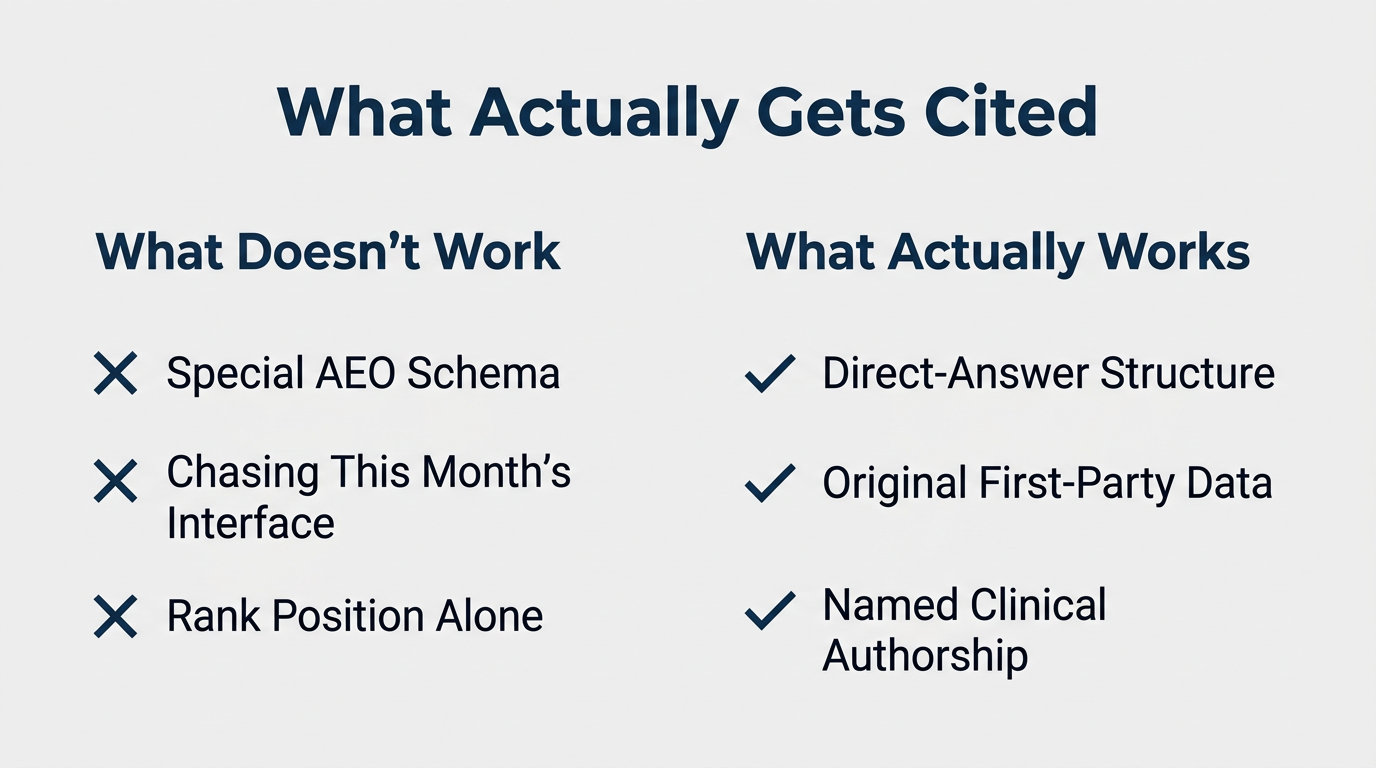
Psychiatric practices get cited by AI search and answer engines by publishing pages that are clear, authoritative, and extractable. There is no magic healthcare AEO markup that guarantees citation. The durable strategy is direct-answer content, credible authorship, clinically careful language, structured data that describes the page truthfully, and strong traditional search visibility.
What AI search changes
AI answer engines reward pages that can be summarized without losing their meaning. A page should answer one question directly near the top, then support that answer with definitions, steps, examples, caveats, and FAQs. For psychiatric practices, the caveats matter. AI systems can flatten nuance, so the page should state what the practice does, what it does not do, when a human clinician is needed, and how crisis situations are handled.
What not to chase
Do not build around this month’s AI interface trick. The manuscript’s core warning is that answer engines keep changing faster than practices can reasonably retool. Build the durable thing: expert pages that are useful for patients, readable by machines, internally linked, and connected to real services. Schema helps clarify what the page is; it is not a substitute for authority.
AEO page structure
Use a short answer block, then headings that match real questions: who this service is for, what happens in the first appointment, what insurance or payment questions matter, what symptoms or diagnoses are commonly involved, and what next step a patient should take. Add FAQ schema only for real FAQs on the page, not as a pile of keyword-stuffed questions.
Implementation checklist
- Put a direct answer in the first 150 words.
- Use descriptive H2s that mirror patient questions.
- Add citations or clinical review where claims become medical.
- Use FAQ schema for actual visible FAQs.
- Measure AI-search impact through overall organic search and conversions, not a fake standalone AI metric.
Frequently asked questions
Is there special schema for AI Overviews?
No special schema guarantees inclusion. Use schema to describe real page content accurately.
Can a small psychiatric practice compete in AI search?
Yes, especially on local, condition-specific, and insurance-specific intent where generic national sites are less useful.
Should answer-engine content sound clinical or simple?
It should be clinically accurate but plain enough for a patient or caregiver to understand quickly.