
The answer in one paragraph
A ninety-day psychiatric practice growth plan should diagnose the bottleneck, ship one working operating layer, and measure whether the constraint changed. The sequence is diagnose, build, connect, measure, then expand.
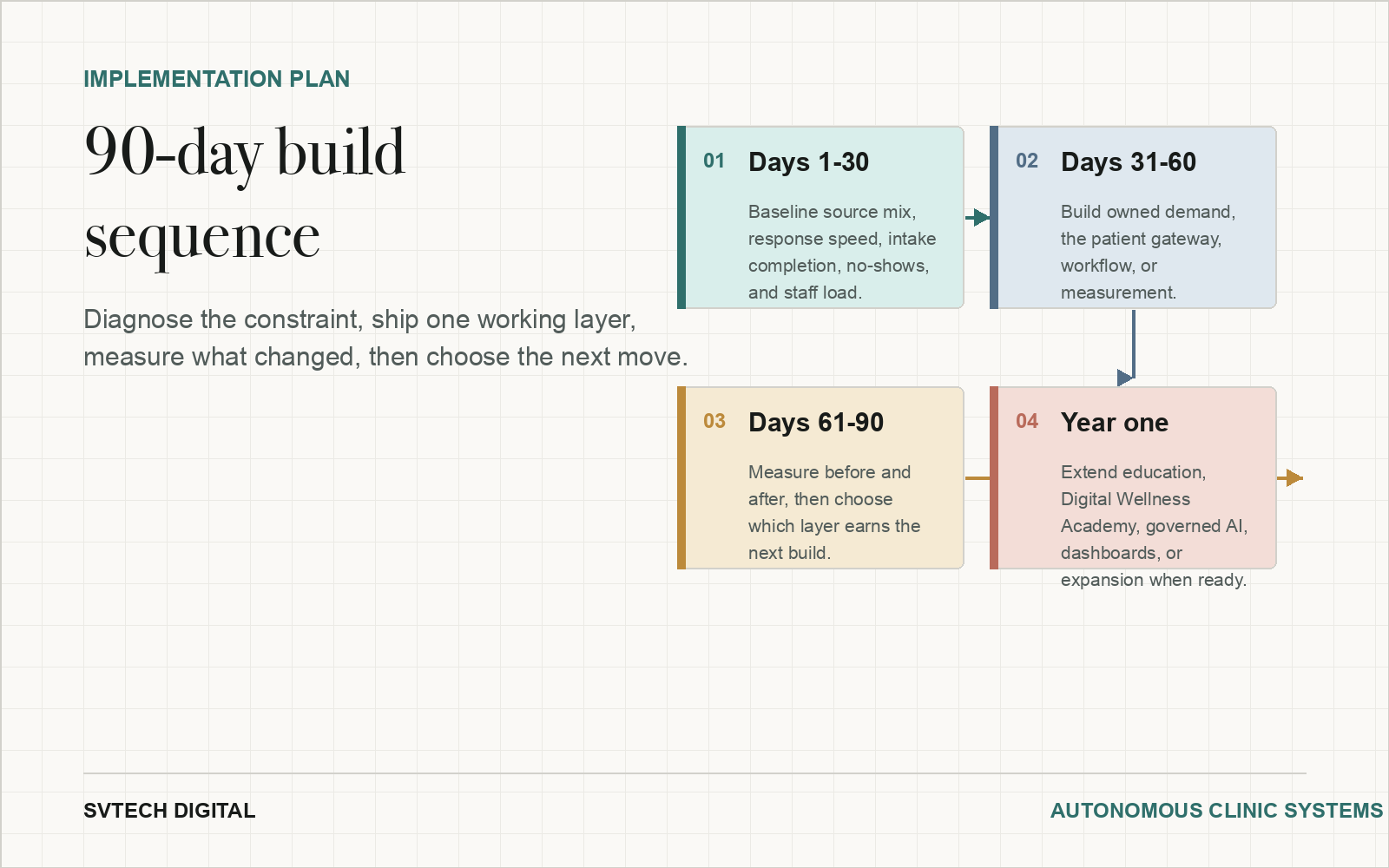
Days 1-30
Map current demand sources, response time, intake completion, booked visits, no-shows, staff touches, Search Console, and the highest-friction workflow.
Days 31-60
If demand is weak, build owned acquisition. If intake is slow, build the patient gateway. If team coordination is the constraint, document task lanes and handoffs.
Days 61-90
Connect analytics, conversion tracking, intake completion tracking, and a monthly review rhythm. Let the evidence choose the next layer.
The ninety-day plan starts with a diagnostic
The first mistake in practice growth is assuming the bottleneck is obvious. Owners often feel the loudest pain and build around that, but the loudest pain is not always the binding constraint. A practice may complain about marketing while quietly losing inquiries through slow response. Another may complain about intake while lacking enough qualified demand to justify a complex automation build.
Use the first month to collect facts: source of the last twenty new patients, Search Console performance, Google Business Profile activity, page-level inquiries, form starts, form completions, response time, scheduled visits, no-shows, staff touches, and the workflow most dependent on one person's memory. That information decides the first build.
Days 1 to 30: establish ground truth
During the first thirty days, do not buy a major platform or launch a broad campaign. Build the baseline. Identify whether the practice is acquisition-limited, operations-limited, or both. Document the current inquiry path, the current intake path, the current scheduling path, and the current staff handoff process. Pull existing analytics even if they are messy.
This is also the right time to put basic AI governance in place. If staff are experimenting with public tools, dictation tools, note tools, or workflow shortcuts, the practice needs a written line around approved tools, PHI handling, BAA status, review expectations, and escalation. That policy can be simple, but it should not wait.
Days 31 to 60: build the first layer
If the practice is acquisition-limited, build owned demand first. That may include Google Business Profile improvements, service pages, condition pages, insurance pages, referral resources, content structure, schema, calls to action, and basic tracking. The goal is not to publish filler. The goal is to create pages that match real patient and referral intent.
If the practice is operations-limited, build the patient gateway first. That may include a better inquiry form, response templates, eligibility questions, e-signature flow, reminders, scheduling readiness, status tracking, and staff routing. The goal is to make new patient interest easier to complete, not simply more automated.
If both constraints are present, stabilize the gateway enough that new demand has somewhere to go. Organic content can begin in parallel, but do not create a surge of inquiries into a process that is already leaking.
Days 61 to 90: measure and decide
The last thirty days should compare the new layer against the baseline. If owned demand was the build, review impressions, clicks, page engagement, inquiries, form starts, completed intakes, and booked visits. If intake was the build, review completion time, missing information, staff touches, scheduled visits, and no-shows. If workflow was the build, review task aging, handoffs, repeated exceptions, and staff clarity.
The next decision should come from what changed. A practice that improved demand but still loses inquiries needs gateway work. A practice that improved intake but has thin demand needs owned visibility. A practice that improved both may be ready for patient education, between-visit support, advanced reporting, or more sophisticated AI-enabled workflows with governance.
What should wait until year one
AI front desk tools, Digital Wellness Academy integrations, advanced dashboards, multi-location expansion, and complex care-between-visits programs can be valuable. They should not be bundled into the first ninety days unless the practice already has the foundation to support them. Otherwise, the project becomes activity rather than operating leverage.
Year one is where the practice can expand from one working layer to a more complete system: owned demand, patient gateway, nervous system, care-between-visits support, and intelligence loop. The ninety-day plan earns that expansion by making the first system visible and useful.
Related SVTech Digital resources
For the underlying strategy, read The Autonomous Clinic book page. For the model, read the five-layer operating system. For implementation options, review SVTech Digital services.
What makes the plan realistic for a small practice
A two-to-twenty-clinician practice usually cannot pause care delivery to run a transformation project. The plan has to fit inside a busy operating environment. That means the first build must be narrow enough to ship, visible enough for staff to use, and measurable enough for the owner to judge. A plan that requires every staff member to change every habit at once is unlikely to survive the month.
The owner should assign one internal lead even if that person is not a formal project manager. Someone has to confirm content, approve workflow rules, gather staff feedback, check whether forms and reminders are working, and review the numbers. Without that owner, the plan becomes a folder of good intentions.
The most realistic win is one working layer: a clearer set of owned demand pages, a better patient gateway, a documented handoff process, a basic measurement dashboard, or a governed education path. Once that layer works, the practice has earned the right to build the next one.
90-day visual
The plan should fit a busy practice.
The 90-day guide now has a visual sequence for diagnose, build, measure, and year-one extension.
Implementation signals
Frequently asked questions
Why not start with ads?
Ads can add volume, but they do not fix weak authority, poor intake, or staff overload.
What is a realistic first win?
A measurable lift in organic inquiries, completed intakes, booked visits, or staff time saved.
Can between-visit care be part of the first ninety days?
Yes, if the demand and gateway layers are already stable enough to support it.