
Guides
Practice growth guides built for search and answer engines.
Each guide answers a specific owner-level question about organic demand, patient intake, workflow, or practice intelligence.
Guide map
The blog follows the operating model.
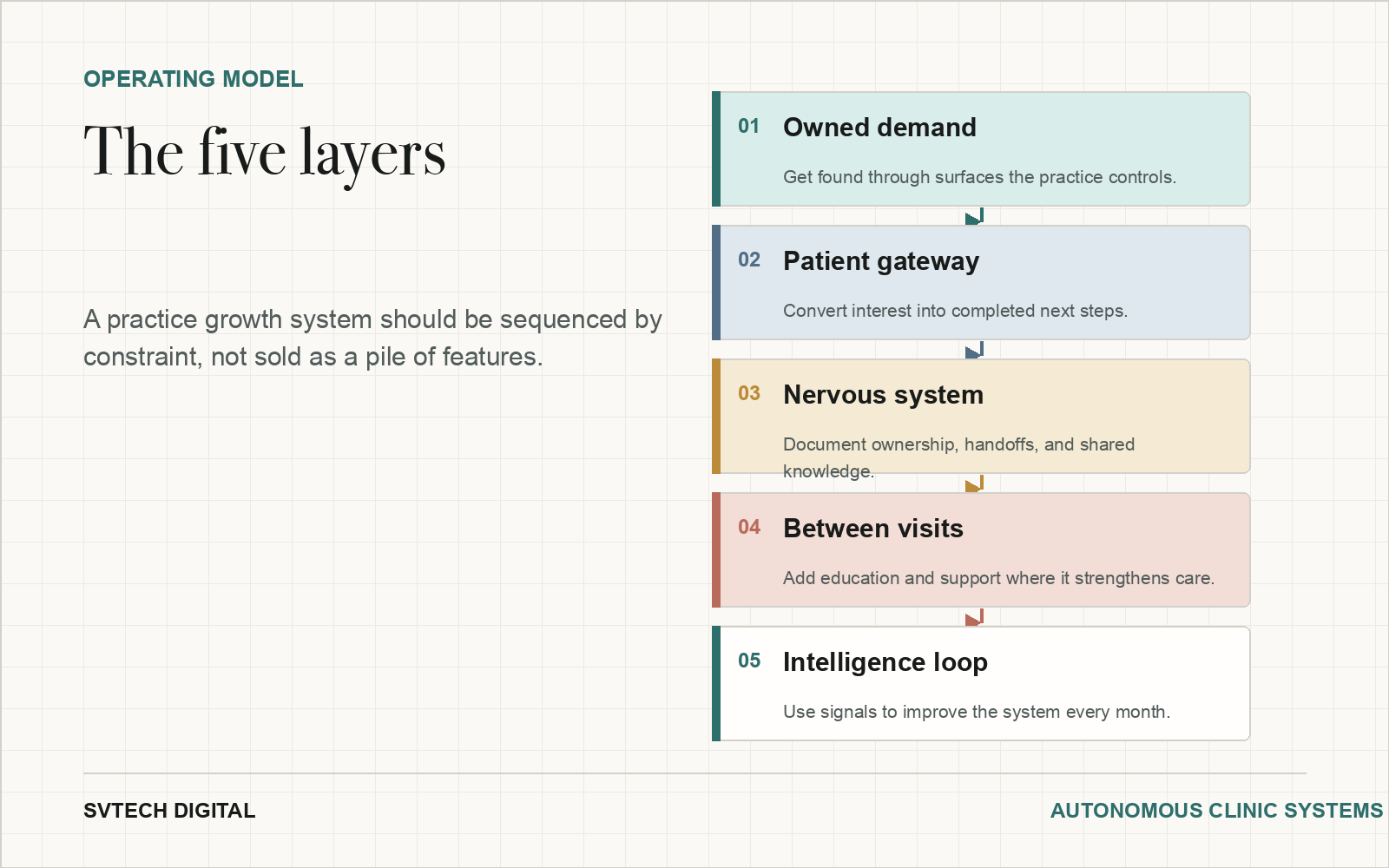
The blog hub now has a visual map so readers understand why the guides are grouped around demand, intake, workflow, between-visit support, and intelligence.
A healthcare SEO strategy for psychiatric practices should build owned demand.A healthcare SEO strategy for psychiatric practices: demand mapping, service and local pages, clinical trust, answer-engine visibility, schema, intake conversion, and measurement.Owned demand guide
Patient intake automation turns demand into prepared care.How psychiatric practices can automate forms, signatures, scheduling readiness, reminders, and routing without removing clinical judgment.Patient gateway guide
A practice intelligence loop turns friction into better decisions.How psychiatric practices can use search, intake, no-show, patient-question, and staff-load data to improve growth and operations.Practice intelligence guide
A ninety-day growth plan should ship one working layer.A 90-day growth plan for psychiatric practices that starts with constraint diagnosis, owned demand, intake automation, and measurement.Implementation guide
Topic cluster
These guides are organized around the practice growth system.
The blog should do more than publish keyword pages. It should build a topic cluster around the questions a psychiatric practice owner asks while deciding what to fix first. The central path is owned organic demand, patient gateway, practice nervous system, between-visit care, intelligence loop, implementation, and economics.
Each guide is written to serve human readers, traditional search, answer engines, and large language model summaries. That means the answer appears early, the headings are direct, the definitions are clear, the practical steps are explicit, and the page connects to related resources instead of standing alone.
The best reading order depends on the constraint. If the practice lacks qualified demand, start with the owned demand guide. If inquiries are already arriving but failing to schedule, start with intake automation. If the owner has plenty of anecdotes but little measurement, start with the practice intelligence loop. If the practice needs a practical first sequence, start with the ninety-day plan.
What will be added next.
The current cluster covers the foundation. The next expansion should deepen the specific searches practice owners and referral partners already make.
How to use the guides
Read for the bottleneck, then follow the internal path.
The blog is meant to work like a diagnostic library. A practice owner should not have to guess whether to start with SEO, intake, workflow, patient education, or analytics. Each article should make the first decision clearer by naming the constraint, explaining the system principle, showing the first build, and linking to the related layer.
For acquisition problems, the SEO guide explains how owned organic demand differs from directory dependence and why service-line pages usually matter before generic blog posts. For intake problems, the automation guide shows how the patient gateway should move an inquiry toward prepared care without removing human review. For measurement problems, the intelligence guide explains how search, forms, no-shows, staff exceptions, and patient questions become a monthly improvement loop.
The ninety-day guide ties those ideas together into an implementation sequence. It is intentionally practical because most psychiatric practices cannot stop operating while they redesign operations. The goal is one working layer, one owner, one measurement rhythm, and one next decision based on evidence.