
The answer in one paragraph
A practice intelligence loop collects the signals already created by growth and care operations, then uses them to improve pages, intake, handoffs, patient education, staffing, and follow-up. It is not a vanity dashboard. It is a monthly decision rhythm.
Signals worth capturing
Search queries, high-intent pages, form abandonment, response time, intake completion, no-shows, staff touches, recurring questions, content gaps, and service-line demand all show where the system needs work.
How to use it
Review the signals monthly. Choose one bottleneck. Improve the page, workflow, message, education layer, or staff rule. Then measure the next month against the baseline.
What to avoid
Do not track metrics that do not change decisions. A smaller dashboard that drives action is better than a larger dashboard that creates theater.
The dashboard is not the point
A practice intelligence loop is not a decorative dashboard. It is a disciplined way to decide what to improve next. The loop starts with signals the practice already creates: search queries, page visits, inquiry sources, form starts, incomplete packets, response time, no-shows, staff exceptions, patient questions, referral patterns, and service-line demand.
The problem is that those signals usually live in different systems and are reviewed only when something breaks. Search Console shows demand. Analytics shows behavior. Forms show friction. The scheduling process shows delays. Staff messages show repeated confusion. Patient education engagement shows what support is being used. The intelligence loop brings those signals into a monthly decision rhythm.
What signals to collect first
Start with a small set of signals that can change decisions. For acquisition, track organic clicks, impressions, high-intent pages, Google Business Profile activity, and source mix. For the patient gateway, track inquiry volume, response speed, form starts, form completions, scheduled visits, no-shows, and stalled records. For workflow, track staff touches, aging tasks, handoff failures, missing information, and repeated exceptions.
For patient education or between-visit support, track assignments, completion, engagement, recurring questions, and escalations. Avoid measuring everything just because a tool makes it possible. A smaller dashboard that changes behavior is better than a larger one that no one trusts.
How the loop improves organic demand
Search queries and patient questions reveal what people need explained. If patients repeatedly ask about medication management, evaluation timelines, insurance fit, safety policies, telehealth, ADHD testing, postpartum support, or what to expect at the first appointment, the website should answer those questions. That is content strategy built from practice reality, not generic keyword volume.
The loop can also identify pages that attract the wrong audience. If a page gets traffic but no qualified inquiries, the message may be too broad. If a page produces inquiries that staff later reject, the eligibility language may need to be clearer. If a page produces qualified inquiries that stall, the problem may be the gateway.
How the loop improves operations
Operational signals show where staff time disappears. Repeated missing information may mean the form is unclear. Slow response time may mean ownership is ambiguous. No-shows may indicate weak preparation, reminder timing, or fit issues. Repeated handoff failures may mean the practice needs a shared queue, task status definitions, or simpler internal rules.
The monthly review should choose one bottleneck, assign one owner, and define one change. The practice does not need to fix every process at once. It needs a habit of making evidence-based improvements.
Where AI can help and where it should not lead
AI can help summarize large sets of patient questions, classify content gaps, draft internal SOPs, or identify repeated friction themes when the practice has appropriate governance and privacy controls. It should not become an unmanaged shortcut around PHI rules, clinical review, or crisis escalation. The intelligence loop needs trust more than novelty.
The right AI question is practical: can this tool help staff see patterns faster without exposing patient data or making claims the practice cannot defend? If not, the practice should use simpler reporting until governance catches up.
Related SVTech Digital resources
For implementation sequencing, read the ninety-day growth plan. For intake data, read patient intake automation for psychiatry. For the full system, read The Autonomous Clinic model.
The loop should connect growth, care, and operations
Many practices review marketing separately from operations and operations separately from care support. That split hides the real bottleneck. A page may attract the right patient, but the form may confuse them. Intake may work, but onboarding may leave them unprepared. Staff may answer the same question repeatedly, but nobody turns that question into patient education or website content.
The intelligence loop should connect those events. A repeated intake question can become a clearer form field, a FAQ, a pre-visit email, a staff script, and a service-page improvement. A repeated no-show pattern can become a reminder change, a readiness check, or a scheduling policy. A repeated referral concern can become a referral resource.
This is why practice intelligence is an operating capability rather than a reporting feature. The practice is not just collecting data. It is converting lived friction into better system design.
Intelligence visual
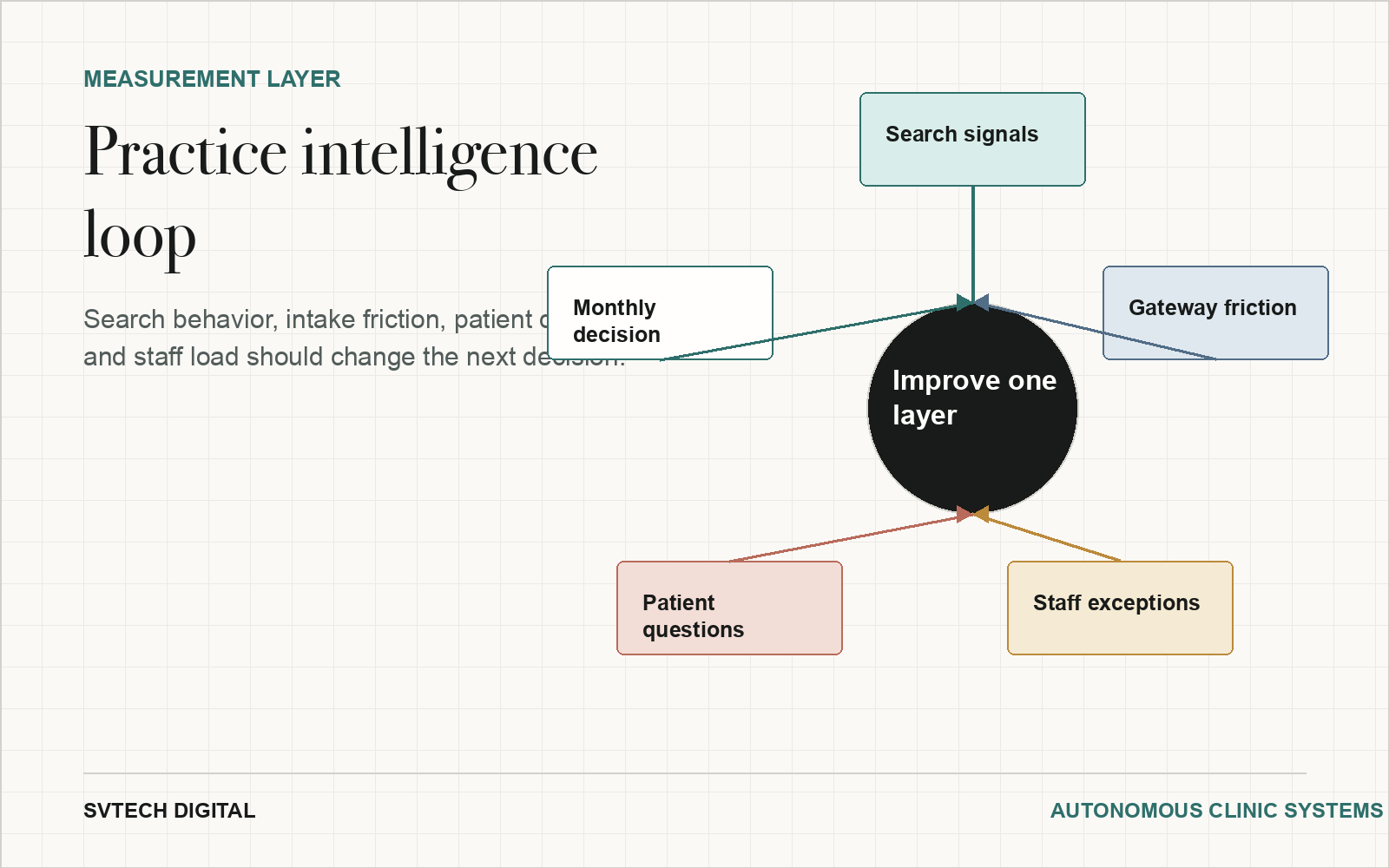
The loop turns friction into decisions.
The intelligence guide now has a visual explanation of how search signals, gateway friction, staff exceptions, and patient questions feed monthly improvement.
Implementation signals
Frequently asked questions
What is the first dashboard a practice needs?
Start with demand, inquiry, intake, booked visits, response time, and staff workload.
Does this require AI?
No. AI may help summarize patterns, but the loop starts with clean operational signals.
How often should the practice review the loop?
Monthly is usually enough for strategic decisions, with urgent workflow exceptions handled sooner.