
The answer in one paragraph
Psychiatric practice SEO should map the searches patients and referrers already make, then build pages that answer those questions, show clinical fit, and route qualified visitors into a clear next step. Directories can still help, but the durable asset is the website, content library, local presence, schema, and inquiry path owned by the practice.
What most practices miss
A directory profile captures comparison traffic, but it rarely captures the most specific searches. Examples include psychiatrist for bipolar disorder near me, adult ADHD evaluation with insurance, or postpartum anxiety psychiatrist in a local market. Those searches need service pages, local authority, credential signals, and a low-friction path into intake.
What to build first
Start with a demand map. List conditions treated, payer questions, service areas, medication-management questions, referral-source concerns, and boundaries the practice must explain carefully. Build pages that answer the question early, explain fit, name provider expertise, and connect to intake.
What to measure
Measure organic clicks, page-level inquiries, form starts, completed intakes, booked visits, and directory dependency over time.
Owned demand versus rented visibility
Most psychiatric practices do not need to abandon directories, referral relationships, or ads. They need to stop confusing those channels with an owned acquisition system. A directory profile can be useful, but the practice does not control the rules, the page structure, the competitive environment, or the way future value compounds. The practice is renting placement in someone else's interface.
Owned demand is different. It lives in the practice's website, Google Business Profile, service-line pages, provider pages, referral resources, educational content, schema, internal links, and conversion paths. The work can be measured, improved, and reused. A strong page can support organic search, answer-engine visibility, referral conversations, patient preparation, and staff explanations at the same time.
Why healthcare SEO is different
Healthcare search sits closer to consequential personal decisions than ordinary product discovery. A page may influence how someone understands symptoms, chooses a provider, or decides whether a service fits. That raises the standard for accuracy, named expertise, review dates, sources, privacy, accessibility, and restraint. The page should explain a service clearly without diagnosing the visitor or promising a clinical outcome.
HIPAA does not prohibit healthcare SEO. It changes how lead capture, analytics, chat, call tracking, testimonials, retargeting, and form data must be evaluated. Keep public educational content separate from patient records, minimize what an inquiry form collects, and review every vendor that could receive protected health information. Marketing tags should not receive sensitive form fields or authenticated patient activity.
Build the demand map before writing pages
A serious SEO plan starts with the searches that matter to the practice's actual services. For psychiatry, that often means condition intent, medication-management questions, therapy fit, evaluation needs, insurance questions, telepsychiatry availability, geography, age group, and referral concerns. A page should not exist because a keyword tool produced a phrase. It should exist because the phrase connects to a real service and a qualified next step.
The demand map should separate broad educational searches from high-intent service searches. A person asking what ADHD feels like may need education. A person searching for an adult ADHD psychiatrist in a specific city is closer to choosing care. Both searches can matter, but they should not be treated as equal conversion opportunities.
What a psychiatric practice website needs first
Before writing weekly blog posts, build the durable pages. The practice needs service pages that explain what is offered, who it fits, what the first step looks like, what insurance or payment constraints exist, and how the practice handles safety-sensitive boundaries. Provider pages should demonstrate credentials and areas of expertise. Location pages should be useful to local searchers, not duplicated filler. Insurance pages should answer affordability and eligibility questions with care.
Educational content comes next. It should answer questions patients and referrers repeatedly ask, and it should point toward a relevant service or intake path when appropriate. In behavioral health, credibility matters because mental health content sits in a high-trust category. Thin pages that sound like generic wellness copy will not carry the authority a practice needs.
Local and technical SEO are the delivery system
Local SEO starts with an accurate Google Business Profile, consistent name-address-phone information, real service areas, complete provider profiles, relevant directories, and a review process that follows platform and professional rules. A location page should prove that the practice serves the area; swapping city names into duplicate copy does not create local authority.
Technical SEO keeps the demand map discoverable. Maintain one canonical URL per intent, descriptive titles, crawlable navigation, useful internal linking, mobile performance, accessible markup, XML sitemaps, correct redirects, and structured data that matches the visible page. Review Search Console exclusions and indexing patterns instead of assuming every published page belongs in the index.
Answer-engine optimization without gimmicks
Answer engines reward pages that are easy to summarize because the page itself is clear. Put the direct answer near the top. Use headings that match real questions. Define important terms. Include FAQs that answer practical concerns. Use schema where it accurately describes the page. Link to the next logical resource. Make the author, organization, and service context obvious.
Google’s current AI-search guidance does not require special AI schema or a separate machine-readable file. The useful work is the same work a credible practice should already be doing: crawlable text, accurate content, clear structure, first-hand expertise, named authorship, trustworthy claims, strong images where useful, and a conversion path that respects clinical boundaries.
Coordinate education with the practice growth system
Service pages should own care-seeking and local intent. A governed education platform should own structured learning, assessments, and between-visit resources. Joining those jobs creates a useful handoff instead of duplicate pages competing for the same query. SVTech Digital maps demand, local discovery, intake, and measurement; Digital Wellness Academy provides the structured patient-education layer.
Measurement for owned demand
Measure organic clicks, impressions, ranking pages, Google Business Profile activity, form starts, form completions, booked visits, and patient source mix. Do not stop at traffic. A practice can attract visitors who never become appropriate patients. The goal is qualified demand that moves into a patient gateway the practice can actually support.
Review the numbers monthly. Pages that bring the wrong traffic need sharper positioning. Pages that bring interest but no inquiries may need better next steps. Pages that produce inquiries but not booked visits may expose a gateway problem rather than an SEO problem.
Related SVTech Digital resources
For the broader operating model, read The Autonomous Clinic model. For implementation options, review psychiatric practice growth services. For the sequence, read the ninety-day growth plan.
Common mistakes in psychiatric practice SEO
The first mistake is publishing generic condition content with no local, clinical, or service context. A page that could belong to any practice is unlikely to create trust for a specific practice. The second mistake is treating blog posts as a substitute for core service pages. A practice should not publish ten anxiety tips while its medication management, ADHD evaluation, or insurance pages remain unclear.
The third mistake is measuring only rankings. Rankings matter, but a psychiatric practice needs to know whether search visibility creates qualified inquiries, completed intake, and booked visits. The fourth mistake is hiding the next step. If a visitor cannot quickly understand fit, availability, location, payment, and how to start, the page is not doing its job.
The fifth mistake is overclaiming. Mental health content needs restraint. The practice should explain services, fit, process, and support clearly without promising outcomes it cannot guarantee.
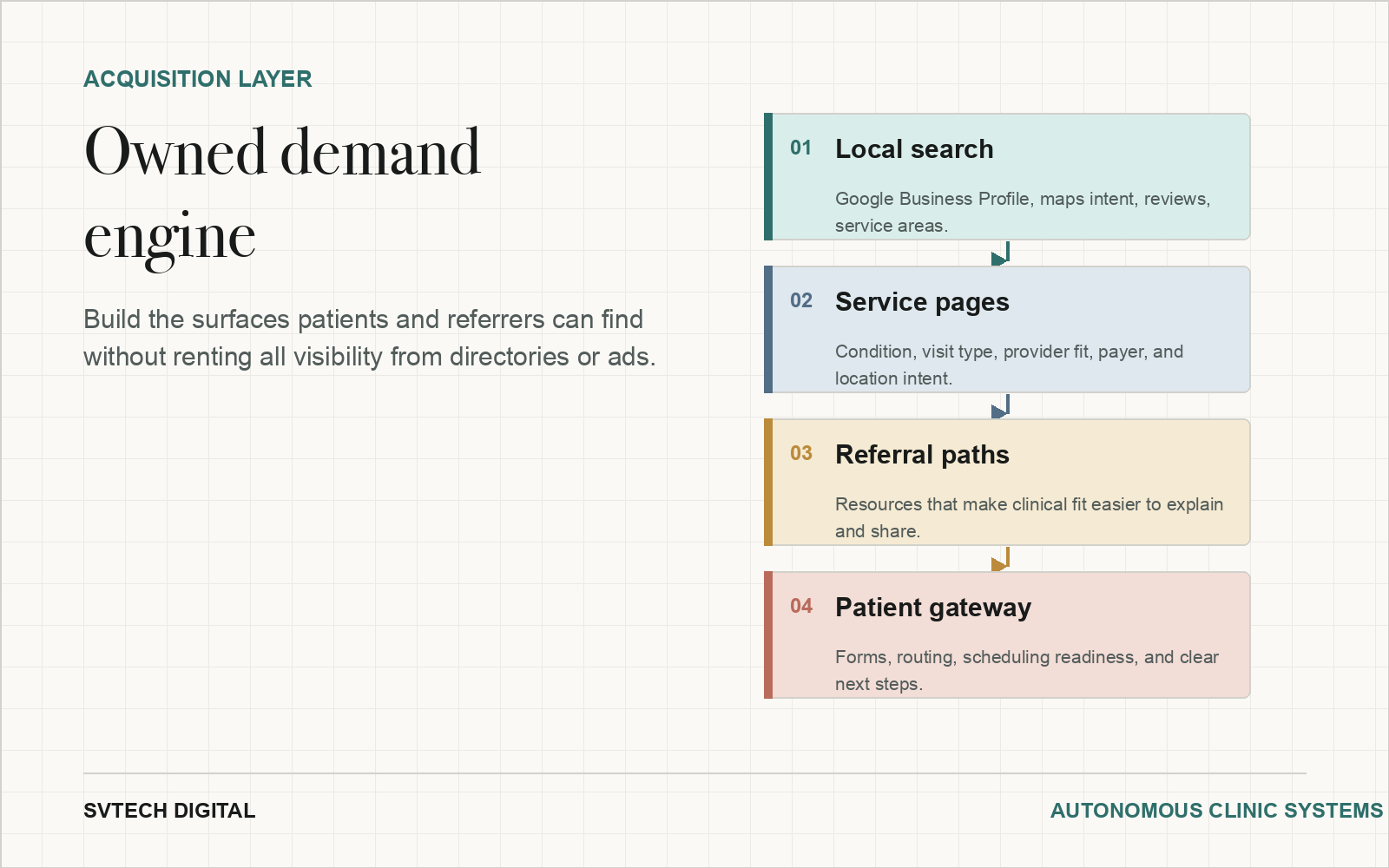
Owned demand visual
SEO has to lead somewhere.
The owned-demand guide now has a clean visual that ties local search, service pages, referral paths, and patient gateway design together.
Implementation signals
Frequently asked questions
Is SEO still worth it for psychiatric practices?
Yes, when it is tied to real patient intent and intake conversion.
Should a practice delete directory listings?
Usually no. Keep useful listings, but stop treating them as the whole acquisition system.
What pages should come before blog posts?
Condition pages, location pages, insurance pages, provider pages, and intake pages usually matter first.
How long does healthcare SEO take?
Technical corrections and click-through improvements can show sooner, but durable non-branded visibility usually compounds over months. Measure page indexing, qualified impressions, clicks, inquiries, and booked visits against a baseline instead of promising a ranking date.
Can a practice do healthcare SEO in-house?
Yes, if a named owner can maintain the demand map, clinical review, local presence, technical quality, publishing, and monthly measurement. Outside help is useful when strategy or implementation capacity is the constraint.
What makes healthcare content trustworthy?
Name the responsible author or reviewer, explain relevant expertise, cite primary sources for consequential claims, show review dates, use accurate schema, separate education from diagnosis, and correct outdated information.